

[My source interview with Bo Yang has been edited for clarity]
I was standing in the showroom of a traditional craftsperson in Milan just over a year ago. We were talking about Pitti Uomo and the Italian sartorial industry. I mentioned that I was working with MAROL, the Bologenese shirtmaker. The craftsperson smiled and said “Oh yes, they’re now owned by…” and used his fingers to pull his eyes into thin slits.
I had done this same action as a child, even though I grew up in a multicultural city. But we didn’t think twice. In our children’s brains, it was a physical reality that Asians had differently shaped eyes than Europeans and it was a quick way to communicate this. A way that was unknowingly, at the time, cruel, minimizing and racist. To experience this again but as an adult, coming from another adult, caught me off guard. I stopped smiling and simply said, “He’s Chinese-Canadian,” and moved on.
Footballers in Italy of sub-Saharan African descent are occasionally pelted with bananas or barraged with monkey chants. The fans who do this, and even some clubs, maintain this is not racist. They say they’re just trying to get under an opponent’s skin. But that skin is a different colour than theirs. And that’s why they’re doing it. A simpler definition of racism is hard to find.
I have heard a number of Italians say, and even tell me, that we in North America are over-sensitive, twisting their actions and motives. But that is the viewpoint of someone so ensconced in their homogenous culture, they cannot see the impact of their actions.

“I don’t pay much attention to that,” Bo tells me. “I couldn’t care less.” This is something you need to know about Bo Yang, MAROL’s owner and managing director. He is exceedingly confident. And that confidence seems to shield him from the slings and arrows of life. I assumed that being of Asian descent, he would have suffered racism in Italy. Even subtle forms, like being accused of buying an Italian heritage brand with the goal of moving production to China. But he’s seen none of that, or at least it hasn’t impacted him. “I couldn’t care less about what they think subconsciously. I don’t pay much attention because I feel that in this global village, it doesn’t matter. It truly doesn’t matter because I believe in meritocracy. If you managed to earn their respect and they look up to you, they understand what you’re trying to achieve. And if they don’t, that’s fine, they’re not worth my time. And most likely, it’s their loss.”
I’m glad to hear, of course, that Bo feels this way. But it’s not to say that his takeover of the artisanal shirt maker has been without problems. Specifically, the financial status of MAROL. “The situation is a lot worse than I had envisioned going in.” When Bo bought the company, unbeknownst to him, it was on the brink of failure. “I did not do my due diligence. It was not an acquisition decision that I did with my banker’s hat on, cause I wouldn’t have done it. Or I would have done it in a much, much different way.”
Bo is first and foremost a businessman. Specifically, he’s worked as a commodities trader, investment banker and hedge fund manager. And above all else, an entrepreneur. A few years ago, when he got to know Hugo Jacomet as he was writing his Italian Gentleman book about the country’s artisans, Bo asked if there were any companies looking for partners. A way for Bo to invest in the industry for which he was developing a passion. Hugo suggested MAROL since the company’s owner, Manuela Vignudelli, was contemplating retirement. So, if Bo didn’t have his banker’s hat on when he made the purchase, was he caught up in the romance of artisanal craft? Not really, he tells me. Instead, it was the art of the deal.
“You always want to make a deal because it’s all the more thrilling when you got something done. This is what we call ‘the deal maker’s bias’.” But something else attracted him to MAROL. “I’m really a left brain type of person when it comes to this. I was mainly caught up with the personalities, with the founder, with the people there [the workers]. There’s a unique aura about them. They were so dignified in the way that they do things, in such a gracious way, with a focus. It’s not romance, this idea of preserving this heritage, preserving this craftsmanship going forward. It was a sense of duty, that this deserves preserving.”
And the shirts themselves? “When I looked at the product, I saw two things. One is I saw quality. They make beautiful things. However, the second thing, perhaps more important, is that I saw something I could contribute because the shirts weren’t all to my taste. There were some shirts that were just bad. Not badly made, but it was just ugly design.” This is something else to know about Bo, he doesn’t mince words. And if you don’t know much about MAROL, or have just heard about them recently, you may not be aware of how they were viewed in the industry before Bo came on board. People would say that their designs could be “aggressive.” Which is a polite way to say “tacky.” The reasons for this might actually stem from the difficulties the company was facing over the last decade. With fewer and fewer retailers interested in stocking such high-end shirts, MAROL tried to differentiate itself by its “creativity,” manifested as wilder and wilder concepts. This is also a reality of Italian design that doesn’t get talked about much in the sartorial world. We are happy to celebrate their classic elegance but we ignore the prevalence of loud, brash and downright gaudy design that is also at the heart of Italian culture. Two sides of the same coin.

When I worked with Bo, much of our focus was on branding, taking MAROL from a predominantly private label business to its own brand. As well as expanding the design focus to include more classic and understated options. I think we were quite successful but then, as Bo entered his second year of ownership, the company’s financial situation was nearing a crisis. He let me go to focus on that. And he has been working to balance the core of the company’s DNA – Italian-made shirts of the highest quality – with the reality of business. “If you want something to be successful, it must profit. This is the golden rule. If you don’t run a viable business then it does not deserve to exist.” Once again, words are not minced.
But, does that golden rule mean Bo will move production out of Italy to save money? No, because he firmly believes that ‘Made in Italy’ matters. “The Italian artisans that go about creating these things, they’re raised in a particular way. They’re raised in a world where priorities are different, where their sense of beauty is different, where the sense of history, the sense of culture, the sense of etiquette is in their blood. That cannot be taught. And that translates into the things that they do.” But Bo believes that changing the way they work is a necessity. “There’s a way of how to put together a product and there’s a way of how to run a business. The first one is a conscious decision: we want the best product in the world. The latter should be as modernized as possible because you’re moving with the times. So if there are things that we can do with a machine that can benefit the product, of course we will look at it. We don’t shy away from it. If you try to make the best shirts in the world, you do whatever it takes and that’s it.”
I’m guessing that if you don’t know Bo personally, this article might make him seem a bit cold. So it may surprise you to find out what drives him, apart from making the company financially viable. It’s seeing MAROL’s shirts become a part of people’s lives. “I give all my time and effort to make the most beautiful shirts in the world, but I don’t want them to be artifacts. I want my clothes to be relevant. We exist on people’s shoulders. We exist on people’s backs.” Bo tells me that seeing his shirts being worn by men around the world, not just men of influence, is why he does it. “This is what I derive the most benefit from.”
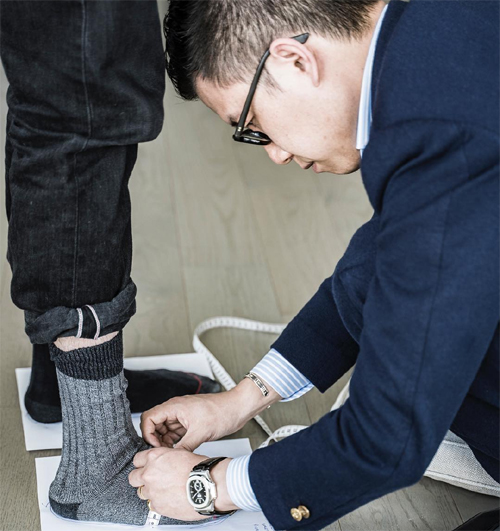
he is also learning from his partners, shoe maker Enzo Bonafe and tailor Pino Peluso.
I appreciate Bo’s vision and what he is trying to do to keep an artisanal brand alive and thriving. But what I appreciate most, because it is sorely lacking in the sartorial world, is his honesty. Perhaps with more honesty we could all look beyond the facade of Italian culture. Still appreciate it for what it can be at its heights while acknowledging and coming to terms with its faults and shortcomings.
[All photos courtesy of MAROL’s instagram]


 thehogtownrake.com
Leave a reply to Pedro Mendes Cancel reply